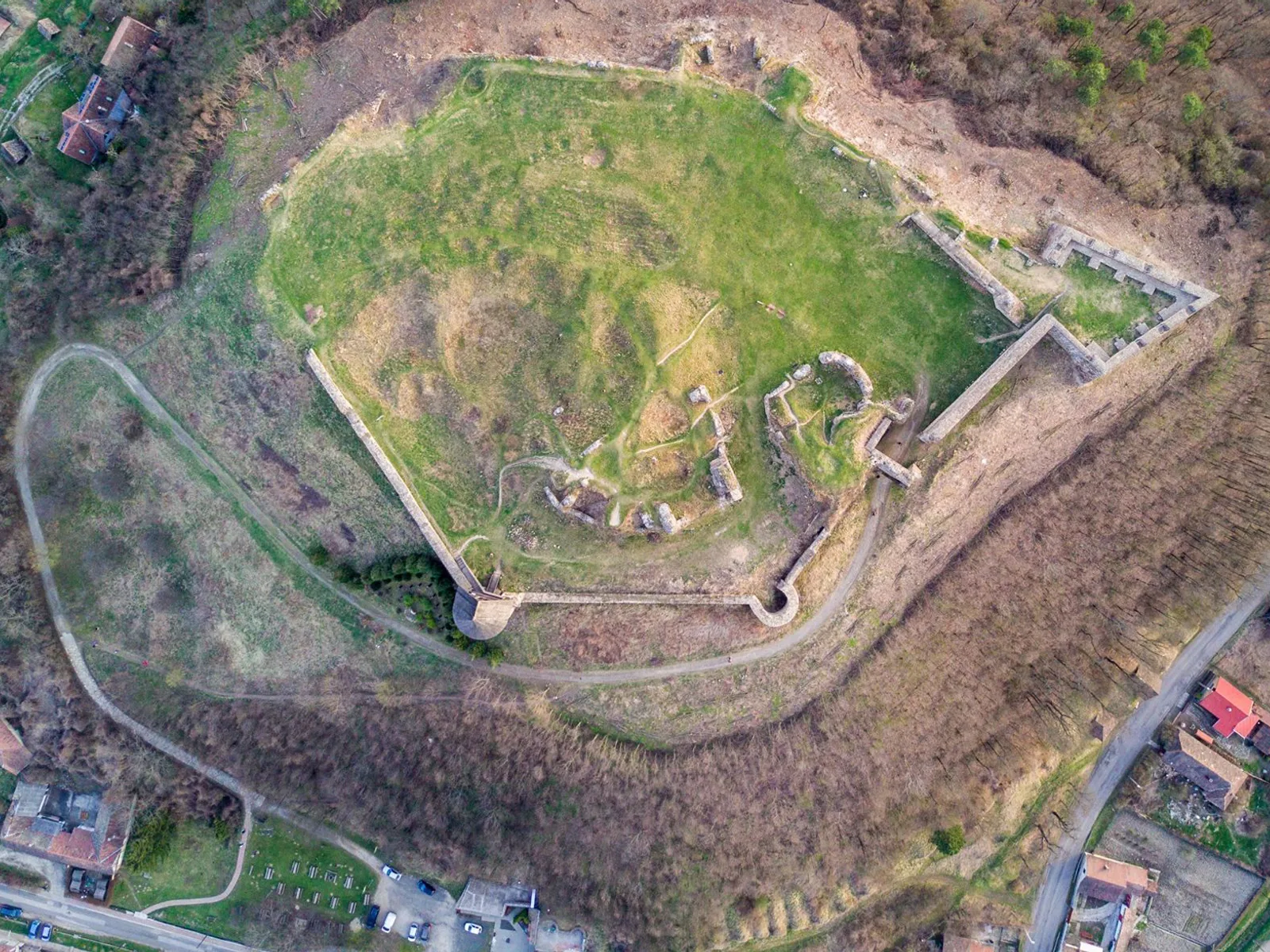
As you can see, the ravages of time have not spared the walls, and this is all that remains of the nearly one-hectare castle. But this guide was created exactly so that we can guide you around the former fortress, using at least your imagination.
This semicircular building, which we call a barbican, protected the bridge leading into the former inner castle. You can encounter a similar gate-defense structure in the castle of Nagyvázsony, where its walls still stand high, and its function and the mass of the building are truly distinct. The barbican originally only connected to the gate tower, but later multiple connecting points to the outer gate were also established.
According to a floor plan made in the 17th century, the building was also used for praying, but the excavations carried out so far have not yet been able to verify such a function.
However, on the side of the building facing the residential tower, they found a former ramp from which one could get onto the bridge leading into the inner castle. It is worth mentioning that today's grassy walking level is on average 1.5-2 meters above the former walking level, so this much humus and debris has filled it up over the centuries, layers full of valuable archaeological finds and treasures.
Speaking of treasures: legend has it that the treasures of Miklós Báthory, the former bishop of Vác, are hidden here within the walls. When the Turks approached Vác, the bishopric first fled to the castle of Nógrád, then further north – however, rumor has it that the treasures were only brought as far as Nógrád. The most extraordinary piece of the treasure is Báthory's six-horse golden carriage. Many have searched for this fabulous wealth, but no one has been able to find a trace of it to this day, even though, according to legend, it must be searched for fifty ox paces from the gate.
The previously mentioned bridge led over a dry moat that was ten meters wide and just as deep, which completely surrounded the former inner castle. Let us help you imagine the dimensions of the moat: there is exactly a ten-meter distance between the barbican and the residential tower – now imagine the same depth.
During the 1949 excavation led by Miklós Héjj, the pillar of the bridge was found, as well as a beautifully carved marble plaque with the coat of arms of Miklós Báthory, which most likely adorned the gate of the inner castle above the bridge. The find is now located in the Hungarian National Museum.
The bridge collapsed long ago, and the moat filled up – so now you can easily reach the next point: the hill of the inner castle.